
Understanding Medical Assistance Claims
IV. MA claims payment histories
Before recovering on a Medical Assistance (MA) claim, you must have an MA claims payment history from DHS to ensure your claim amount is accurate. This section explains how you can receive an MA claims payment history, the information provided on a history, how to determine the claim amount from the history, and last steps to take before asserting a final MA claim amount. It also explains why you must use MA claims payment histories instead of PIN reports for claim amounts, and why a history may provide a different MA claim total if you order a second history at a later date.
A. Receiving an MA claims payment history
There are three ways to receive an MA claims payment history:
1. Receiving an estate claim minimal report through a death match in your MN–ITS mailbox
The estate claim minimal report provides a complete list of paid amounts for all recoverable services an MA member received at 55 years old or older, as long as the MA member was never a permanent resident in a medical institution and did not receive General Assistance Medical Care (GAMC) services before June 1994.
The estate claim minimal report provides paid amounts for the following services from June 1994 through the date on the report:
The beginning of the estate claim minimal report looks like this:

The total claim amount appears at the end of the estate claim minimal report. If the deceased’s case does not have any claim adjustments, the amount will appear in the “ReimbursementAmount” column of the “Grand Total” line:

If the deceased’s paid amounts are adjusted, the total claim amount appears after the adjustments, in the “ReimbursementAmount” column of the “Total Owed” line. An adjustment can add to or subtract from the Grand Total.
Finally, the estate claim minimal report separates paid amount subtotals for MA, AC and GAMC services. In addition, paid amounts for MA may also be separated into certain MA eligibility types, such as MA-AX, MA-BC or MA-NA. These separate subtotals become important when you enter your recovery in MMIS. The separation of an MA eligibility type subtotal on the estate claim minimal report looks like this:

Note about certain DHS adjustments:
If under “Grand Total” there are subtractions for adjustments 669 (ANNUITY), 105 (VLNTR RCVRY DHS), 650 (RCVRY POOLED TRUST DHS), or 107 (MA LIEN RCVRY DHS), this means DHS has collected from the MA recipient or recipient’s estate from all MA or GAMC paid claims. This amount, subtracted from the grand total, is the amount of the recovery that is due to LTSS claims. If the MA recipient received non-LTSS services, it will be lower than the amount the MA recipient or the estate paid to DHS.
2. Receiving an estate claims paid history (ECPH) packet following a notice to the commissioner of human services
After receiving your request, DHS will send you the requested claims payment history. You may get up to three different reports: the standard report, the all-MA-payments report, and the pre–June 1994 report. (Refer to examples. Examples have been redacted to comply with federal and state privacy law.)
a. The post–6/01/1994 LTSS and GAMC report (the standard report)
The ECPH packet contains the standard report, described previously, for the eligibility periods where the recipient was 55 or older, except it will not contain eligibility periods covered by the all-MA payments report (described in section 2b, immediately following).
b. The all-MA-payments report
You will get a report that includes paid amounts for all MA services (not just MA-LTSS) that an MA member received at any age during residence in a medical institution, provided the member:
The beginning of the all-MA-payments report looks like this:

The total claim amount appears at the end of the report after “REIMBURSEMENT AMOUNT.” It looks like this:

c. The pre–June 1994 report
Finally, if the deceased received GAMC services before June 1994, you will get the following report with the total claim amount appearing in the “RECIPIENT TOTAL REIMB AMT” line:

Note: If the deceased received MA services at 55 years old or older before June 1994, and was in a nursing home at the time of services, you will be notified of the total recoverable amount of any MA or GM services after June 1994 and asked if you want to pursue any claims before June 1994. To pursue these claims, you must analyze each MA claim payment that appears on the pre–June 1994 report to determine whether the service falls under the definition of LTSS. DHS does not determine whether those MA paid amounts on the pre–June 1994 report are recoverable. That responsibility falls on you, and it is up to you to determine whether analyzing pre–June 1994 recoverable claims is a cost-effective use of county resources in each case.
3. Requesting an MA claims payment history
Request a claims history when the estate available for recovery is larger than the amount in the minimum claims history report, when the spouse of a predeceased Medical Assistance recipient dies, or any time you would like a complete report of recoverable claims. Follow the form instructions to complete a Request for an MHCP Member's Claims Payment History (DHS-2133).
B. Final steps before asserting your final MA claim amount
1. If you received more than one report, add the claim totals from each report together
The minimal report: If no adjustments were made, use the “Grand Total” amount at the end of the report. If adjustments were made, use the “Total Owed” amount.
The all-MA-payments report: Use the “REIMBURSEMENT AMOUNT” at the end of the report.
The pre–June 1994 report: If the deceased received recoverable MA or GM services before June 1994, add individual claim amounts together using the guidance in section B.3 above.
2. Subtract any AC premiums and any Medical Assistance for Employed Persons with Disabilities (MA-EPD) premiums that were billed to the member
Subtract from the MA claim total any AC and MA-EPD premiums billed to the member during his or her life.
First, determine whether the member received AC or MA-EPD. Look up the member’s ID number in MMIS and check the “RELG” screen to see whether the member had eligibility type AC or DP. Use the examples for a reference. The examples have been redacted to comply with federal and state privacy law.
This is what AC coverage looks like on the RELG screen:
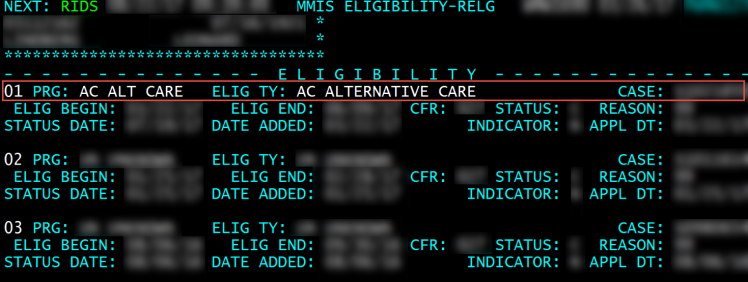
This is what MA-EPD coverage looks like on the RELG screen:

Second, if the member received AC or MA-EPD services, send an email to DHS requesting the premium payments using the following format:
To: dhs.made@state.mn.us
Subject: AC and/or MA-EPD Recovery – Payment History Request
Body: Include the following:
Third, wait for a response from DHS. When DHS emails the total premium amount paid, subtract it from the MA claim total (this includes Alternative Care). This figure is the final MA claim amount.
C. Why you must use claims payment histories instead of PIN reports
The Program Integrity Network (PIN) is a DHS data warehouse investigatory tool that is available to county fraud investigators and collection workers. It allows them to pull MA claims information from the data warehouse. PIN information can be a starting point to figure out what went on in an estate recovery case and estimate the potential MA claim amount.
You can use a PIN report to find out whether a potential MA claim amount exists. If one does, you can then request a claims payment history from DHS. (You can always request a claims payment history without using PIN first.)
However, a PIN report cannot tell you whether all claims contained in the data warehouse are collectible under estate recovery laws. The actual amount of the claim can be larger or smaller than the amount shown in the PIN report. All information obtained from PIN must be verified by a secondary source. You cannot collect on an estate using the claim amounts or claim total in a PIN report.
Before beginning MA estate recovery, you must request a claims payment history from DHS. A PIN report may not be submitted to any party, to attorneys, or to the court.
In summary, you can use a PIN report to investigate whether to begin estate recovery, but you may use only a claim total from a claims-payment-history report to recover on an estate.
D. Why a claims payment history may provide a different MA claim total if you order a second history at a later date
MA providers have one year from the date of service to bill DHS. In addition, amounts billed for MA services may be adjusted at a later date. Consequently, depending on the circumstances, if you order a second MA claims payment history for a deceased MA member at a later date, the MA claim total from the new reports may be different from what was previously reported. Change is the nature of the health care system. If circumstances demand that you order a second MA claims payment history, use the MA claim total from the new reports and revise your MA claim amount to the new total if you have already asserted the old MA claim amount in probate or elsewhere.
 Report this page