
MMIS subsystems
Page posted: 8/3/26
MMIS has 30 subsystems. These subsystems establish and document eligibility, approve payment for services, enroll providers and pay managed care capitation and provider claims. MMIS users can access subsystems to view, add, change or delete data.
The main menu only shows the subsystems you can access based on your assigned MMIS security access group. Your security access group also determines which actions you can take within the subsystems. Your main menu might not include all the subsystems described on this page, and it might look different from your colleagues’ main menus.
This manual includes information about working in screening documents and service agreements, both of which are in the prior authorization subsystem. It also includes information about other subsystems, such the recipient or provider subsystem, as they relate to completing work in the prior authorization subsystem.
How to access subsystems
To access subsystems from the main menu:
1. Press the tab key to move the cursor to the field at the left of the subsystem you want to open.
2. Type X in the field.
3. Press the transmit key to view that subsystem’s key panel screen. A key panel screen is where you identify the type of action you want to take within the subsystem.
4. Enter the action you will take and, depending on the subsystem you selected, the applicable information to identify the person, provider or document number.
For more information about the use of key panel and other screens in these subsystems, refer to MMIS LTSS Manual – About the LTC screening document and MMIS LTSS Manual – About the service agreement.
Subsystems list
MMIS has 30 subsystems that are interdependent and work together. The following sections describe the subsystems most relevant to the information in this manual.
Claims subsystem
The claims subsystem processes payment or denial of health care and other claims for services people receive through public programs. This process interfaces with all other subsystems and supports appropriate claims payment.
Providers submit claims through an electronic mailbox system called MN–ITS.
Recipient subsystem
The recipient subsystem stores information related to eligibility for Minnesota Health Care Programs (MHCP). It contains data for all people who have a person master index (PMI) number, regardless of their eligibility for MHCP. For example, many people have a PMI number because they received a preadmission screening for nursing facility admission. The PMIN function in MAXIS creates and assigns PMI numbers.
This subsystem includes data generated by DHS, the Social Security Administration, the Minnesota Department of Health and MAXIS. It contains a person’s health care program eligibility determination for both state-supervised and county- and Tribal-Nation-administrated programs such as Medical Assistance (MA), MinnesotaCare, Alternative Care, etc.
Some information in the recipient subsystem is populated automatically from other systems like MAXIS, while other information must be entered manually by eligibility workers (also called financial workers).
Eligibility information in the recipient subsystem interacts with information in screening documents and service agreements to ensure the person meets service and financial eligibility requirements for home and community-based services (HCBS).
For more information about the recipient subsystem, refer to MMIS LTSS Manual – Work with a person’s data.
Provider subsystem
The provider subsystem contains information about provider eligibility and qualifications to provide services to people participating in MHCP. All providers, including case managers and care coordinators, must be enrolled. The provider subsystem includes the following types of provider data:
One of MMIS’ primary functions is to ensure DHS pays claims to qualified providers.
Reference subsystem (also referred to as PDDD)
The reference subsystem contains information about:
For example, a procedure code record includes the code, a description of the procedure/service, restrictions (e.g., age, gender) and the dollar amount DHS will pay a qualified provider for delivering that procedure/service to an eligible person. It also includes an indicator for whether a procedure/service requires prior authorization.
Prior authorization subsystem
The prior authorization subsystem collects and processes information about services that require prior authorization before claims can be paid. Certified assessors, case managers, care coordinators, DHS staff and DHS contractors use this subsystem to establish HCBS program eligibility and authorize services and payments to identified providers. The prior authorization subsystem also ensures proper monthly capitation rates paid to managed care organizations (MCOs) that manage and administer HCBS programs.
The prior authorization subsystem is where lead agency assessors, case managers and care coordinators complete most of their work. Lead agency staff may navigate to and inquire in other subsystems, but they have little or no ability to add to or change information outside of the prior authorization subsystem.
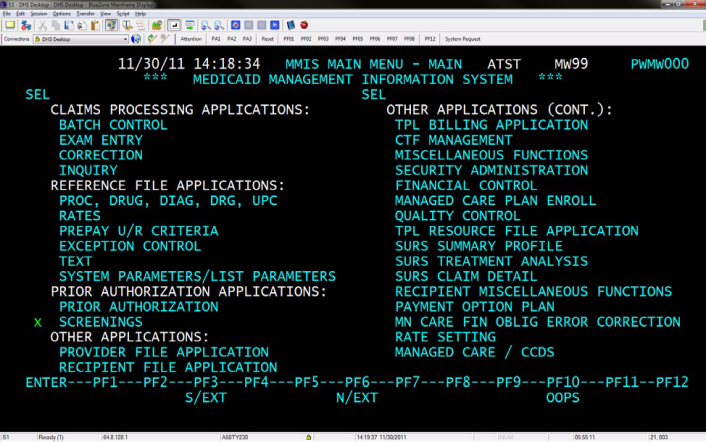
The prior authorization subsystem includes both screening documents (i.e., screenings) and service agreements (i.e., prior authorization). Staff select the part of the prior authorization subsystem they need to access in the MMIS main menu.
Figure 1: MMIS main menu screen with an X on the screenings line.
The prior authorization subsystem processes the required data entry, maintenance and approval of:
For more information, refer to MMIS LTSS Manual – About the LTC screening document and MMIS LTSS Manual – About the service agreement.
Quality control subsystem
The quality control subsystem contains information DHS uses to review samples of all claims paid to determine under- or over-payments, which is a federal requirement. Currently, this subsystem runs a monthly sample of claims to review for provider billing and/or claims examiner pricing errors. It provides an audit of MMIS. Only DHS staff can access this subsystem.
Surveillance and Integrity Review Section (SIRS) summary profile, treatment analysis and claim detail subsystem
The SIRS summary profile, treatment analysis and claim detail subsystem develops exception reports about provider and recipient data that compare claims to determine if there are areas that need further review. Exception reports helps DHS identify potential MHCP fraud or abuse and MMIS system performance issues.
Data security subsystem
The data security subsystem controls access to MMIS information through mainframe software (ACF2) and application software written specifically for MMIS. ACF2 prevents unauthorized access to the MMIS login screen, and the application’s security prevents unauthorized access to specific data elements, subsystems or screens.
DHS MMIS security staff work with security liaisons located in each county, Tribal Nation and MCO, as well as in each division within DHS, to grant access when needed.
Medical Assistance Reporting System (MARS) subsystem
The MARS subsystem produces and stores the reports required by the federal Centers for Medicare & Medicaid Services (CMS) as part of the conditions of federal financial participation (FFP) for MA expenditures. Only DHS staff can access this subsystem.
Financial control subsystem
The financial control subsystem gives financial workers the ability to:
Obligations include both payment and collection liabilities of DHS, the county and people receiving services. County workers or DHS staff create and change obligations.
This subsystem interfaces with the MMIS third-party liability (TPL) resource file, recipient file, provider file, claims processing file, MARS subsystem and daily recipient file.
Third-party liability (TPL) subsystem
The TPL subsystem maintains insurance carrier information for billing and reporting to providers. It has two selections: TPL billing application and TPL resource file application.
DHS Benefit Recovery uses the TPL billing application to collect recovery payments on paid claims with possible TPL.
The TPL resource file application:
County or Tribal Nation financial workers can add or update the information in this subsystem. This activity helps ensure third-party payers pay for health care before using state and federal funds.
Drug rebate subsystem
The drug rebate subsystem conducts a monthly download of use data for drugs reimbursed by MA. It also creates quarterly drug rebate invoices by combining the use data with unit rebate amounts CMS provides. DHS uses the drug rebate subsystem to provide invoices to manufacturers. This subsystem does not track payments or resolution of disputes.
Managed care subsystem
The managed care subsystem
Reports subsystem
MMIS generates thousands of reports. Infopac is the mainframe report distribution software that stores these reports. It retains multiple versions of each report and filters reports by agency (e.g., county, Tribal Nation or MCO). MMIS generates reports on a schedule depending on the need: daily, biweekly, monthly, quarterly, annually or on request. For information about reports lead agencies commonly request, refer to MMIS LTSS Manual – Use Infopac reports.
Resources
MMIS LTSS Manual – About the LTC screening document
MMIS LTSS Manual – About the service agreement
MMIS LTSS Manual – Use Infopac reports
MMIS LTSS Manual – Work with a person’s data
 Report this page