

Initial assessment review: Detailed guidance
Updated 10/20/2025
This webpage supplements CBSM – Initial assessment review (IAR) for home and community-based services (HCBS). Review the CBSM entry before this webpage.
Definitions
External factors
Eligibility and/or other criteria that are determined outside of a MnCHOICES assessment. These factors include but are not limited to:
- Determination of disability status (i.e., Social Security or State Medical Review Team [SMRT])
- Determination of Medical Assistance (MA) eligibility
- Determination of Alternative Care (AC) or Essential Community Supports (ECS) financial eligibility
- Status of developmental disabilities (DD) diagnostic determination
- Delay of proposed discharge date from an institutional stay
- Delay program start because a person chose to.
Functional criteria
Level of care and/or program criteria that is determined by the MnCHOICES assessment. The assessment determines needs in areas like:
- Activities of daily living.
- Memory, using information, daily decision-making or behavioral needs requiring intervention.
- Formal clinical monitoring at least once a day.
For example, a person might meet functional criteria for the Brain Injury (BI) Waiver but their SMRT determination is pending. This is an external factor. Review how this appears in the Assessment results section shown below.
For more information, go to CBSM – Waiver and Alternative Care programs overview and CBSM – Level of care.

Initial assessment with no level of care or program met
No functional criteria for institutional level of care and program were met
If a person did not meet functional criteria for any level of care or program, then an IAR cannot be used to start a person in a program following an initial assessment. A person whose needs or circumstances change so they now meet level of care or program criteria must have a new initial assessment.
Essential Community Supports (ECS)
A person must not meet any level of care to start the ECS program. An IAR may be used when a person 65 years old or older who has pending external factors wants to use ECS. For more information, go to CBSM – Essential Community Supports (ECS).
Community First Services and Supports (CFSS)
Definition — Initial assessment
An assessment completed for a person who is not receiving services through a waiver or other program. Because of Medicaid Management Information System (MMIS) constraints, all CFSS assessments are coded as “initial assessments.” For IAR policy purposes, annual assessments for people who receive CFSS services are considered reassessments and cannot be followed by an IAR.
Exception: If the reassessment is done in person and the need for a waiver becomes evident, the assessor can complete the MnCHOICES assessment as an initial assessment. Then, an IAR can be used if the person has external factors pending.
(Note: An IAR cannot follow a reassessment done remotely.)
Using CFSS before opening to a waiver
When a person starts using CFSS after an initial assessment and they want to open to a waiver, an IAR must be used.
After completing the IAR, the lead agency must take the following steps:
- The Type B service agreement must be ended.
- The screening document for the IAR is entered to start the applicable waiver.
- The CFSS support plan is updated to end the service lines and CFSS span.
- A new support plan with applicable waiver type is created.
- The standard service agreement for all programs is entered.
(Note: The start date of the waiver and service agreement span is the IAR effective date. The end date will stay the same as the initial assessment which creates a limited span.)
Person with pending external factors is functionally eligible for CFSS
When a person has an initial assessment, wants to use CFSS and has pending external factors, the lead agency:
- Enters a screening document in MMIS as no program.
- Creates a support plan.
- Enters the Type B service agreement with DHS no pay code in MMIS.
When external factors are determined, the lead agency does an IAR in MnCHOICES with the person. Then, the lead agency:
- Enters a new screening document into MMIS as no program.
- Completes the support plan.
- Enters the new Type B service agreement in MMIS. Enter the consultation service provider, if known.
(Note: If initial assessment results show a person is functionally eligible for a waiver but they did not want to start a program at that time, a second IAR must be done within 365 days of the initial assessment to start them on a waiver.)
CFSS homecare rating changes at the IAR
The IAR can change the person’s needs from those shown in the initial assessment. This includes changes that affect CFSS home care rating and hours/units.
Effective date
When to use the initial assessment activity date as the effective date for an IAR
The effective date is the date a person will start receiving services of any kind (within 60 days of the activity date). Use the activity date of the initial assessment only when the person is already receiving services that require waiver or program funding.
(Note: External factors must have been met as of the activity date of the initial assessment.)
Example: A person living in a customized living facility had a MnCHOICES assessment July 1, 2025. They wanted EW funding to pay for these services. On Oct. 1, 2025, the assessor learned the person’s MA was approved as of Aug. 1, 2025. The effective start date of the waiver span must be Aug. 1, 2025, instead of July 1, 2025.
IAR needed in the last 60 days
Person needs an IAR
An assessor might need to use an IAR about 60 days before the end of the allowed 365-day validity span. This is usually for a person who already receives services and needs program funding or a person who has an immediate need for services.
Person does not need an IAR
In most cases, a new initial assessment should not be completed for a person if external factors were not determined until they were near the end of the allowed 365-day validity span, and they did not need to use services immediately or before the date of the initial assessment review.
Both an IAR and reassessment are needed
An assessor might need to use an IAR toward the end of the allowed 365-day validity span. This might be the same timeframe that a reassessment must be completed. An assessor can use the same activity date for the IAR and reassessment if the dates align, the lead agency is responsible for both actions and the lead agency permits this practice.
Directions
To complete an IAR and reassessment on the same day, a certified assessor must create a MnCHOICES assessment form with “IAR” selected as the assessment type. They must complete the IAR, then complete and send an assessment summary to the person. After that, the screening document is entered in MMIS.
Next, the certified assessor must create a MnCHOICES assessment form with “Reassessment (RA)” selected for assessment type. They will complete the assessment summary and send a copy to the person. Lastly, the reassessment screening document is entered in MMIS.
Person turns 65 years old between the initial assessment and IAR
A person who turns 65 years old between the activity date of the initial assessment and the activity date of the IAR might be able to use a disability waiver if it best meets their needs.
A person must meet the following conditions to be eligible for Community Access for Disability Inclusion (CADI), Community Alternative Care (CAC) or Brain Injury (BI) waivers after they turn 65 years old:
- Be 64 years old at the time of the initial assessment.
- Meet functional criteria for a CADI, CAC or BI waiver. (Go to CBSM – Waiver and Alternative Care programs overview for specific waiver criteria.)
- Pending criteria became effective while they were still 64 years old.
Example: A 64-year-old person was assessed and met functional criteria for a CADI Waiver on July 1, 2025. Her SMRT application was pending until Nov. 1, 2025, which was after she turned 65 years old. SMRT confirmed her disability status on the date of her application, which was also July 1, 2025. She can use the CADI Waiver because she was still 64 years old on July 1 (the date SMRT used to determine her disability status).
How to manage in MnCHOICES
The certified assessor must choose a result date that is before a person’s 65th birthday when they meet eligibility for and choose to use a CADI, CAC or BI waiver after turning 65 years old to provide accurate assessment results. (MMIS has been programed to allow this.) The effective date does not have to happen when the person is still 64 years old.
Multiple IARs
An IAR should only be used when the assessor confirms that a person is ready to open to a program.
Example: An IAR does not need to be completed for a person going on a BI Waiver when their MA application is approved and a SMRT determination is pending. However, there might be circumstances when multiple IARs are completed.
CFSS
- An initial assessment is completed for CFSS, but there are pending external factors.
- An IAR is used to open a person to CFSS via the Type B service agreement.
- A second IAR will be used to start a person on a waiver, later.
CFSS and MMIS
All screening documents must be entered into MMIS according to CFSS policy.
Waiver
- An initial assessment is completed for a waiver, but there are pending external factors.
- An IAR is completed because of a planned discharge from a facility that did not occur.
- A secondary IAR is completed to start the person on a waiver once they get discharged from the facility.
Waiver and MMIS
All screening documents must be entered into MMIS.
If an IAR screening document showing a person started on a program was entered into MMIS but the person did not open to a program, the assessor must request a screening document deletion. For more information, go to CBSM – Service Agreement and Screening Document (SASD) Support Team.
What to send to the person
Any time an assessment is completed, an assessment summary and notice of action must be sent to the person. The lead agency does not need to complete the assessment and program acknowledgement (including signatures) or complete MnCHOICES Assessment Summary Worksheet, DHS 6791A (PDF), as part of the IAR.
Tracking
Queries
A new query — “Initial assessment tracking” — is available on the queries tab under MnCHOICES assessment.
Reports
A new report — “Assessments with pending criteria” — is available to staff with certain roles on the reports tab. These roles include:
- Lead agency supervisor
- Delegate supervisor
- Contracted case management supervisor.
Tasks
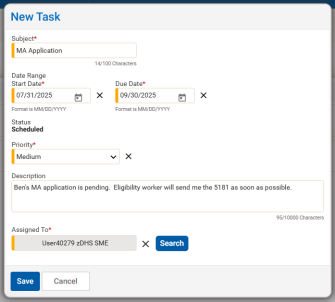
A task can be created by clicking on the tasks icon in a person record and selecting the new task button. Once a task is created, it will appear after opening the my tasks tile of My dashboard.
Example of a new task
Person lives in a customized living facility and EW funding is pending
The lead agency responsible for the MnCHOICES assessment must start a support plan when a person has customized living services and requests an initial assessment for EW funding, but they cannot start the waiver within 60 days of the assessment.
Workflow example
July 1, 2025: A certified assessor assesses a person for EW who receives customized living services.
Aug. 29, 2025: The person’s MA (or other external factor[s]) is/are still pending.
- A certified assessor follows assessment protocol, moving it to the approved by MMIS status.
- A lead agency staff member creates a support plan form.
- Lead agency staff moves the support plan from In progress to In progress – Assessment complete status.
(Note: The lead agency keeps the support plan in this status until a case manager or care coordinator is assigned.)
- Lead agency staff prints the support plan and uploads it under the attachments icon in a person’s record.
(Note: Do this to make sure the assessed needs in the Elderly Waiver Residential Services (EWRS) tool identified at the time of the initial assessment appear accurately in the support plan printout.)
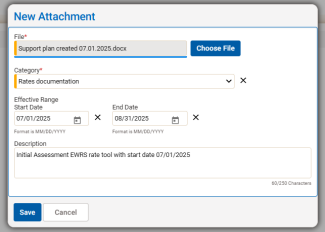
(Note: Go to MnCHOICES Practice Guide – MnCHOICES Support Plan form in the application help center for help creating a plan and for information about the EWRS tool.)
Nov. 2, 2025: The certified assessor learns the person’s MA has been approved effective July 1, 2025.
- The assessor creates a MnCHOICES assessment with “Initial assessment review” selected for assessment type.
- The assessor updates the assessment information if the person says something has changed.
- The assessor follows assessment protocol that includes moving the assessment to the Approved by MMIS status.
After Nov. 2, 2025: Case manager or care coordinator is assigned. (Some lead agencies might want the certified assessor to complete these steps.) Following lead agency protocol, the lead agency staff member will:
- Check the support plan that was started by the certified assessor or other lead agency staff member for date accuracy.
- Update the support plan effective date range as well as services and supports date ranges (if necessary).
- Add additional services and supports to the support plan (if needed).
- Complete any remaining fields.
- Send the support plan under the attachments icon and updated support plan to the customized living provider if the EWRS tool had fewer assessed needs.
(Note: This allows the provider to see the accurate component services in the EWRS tool in each version of the support plan.)
 Report this page