
MHCP Member Evidence of Coverage
Overview
This evidence of coverage (EOC) is for people who have fee-for-service coverage through Minnesota Health Care Programs (MHCP). An EOC explains your health care coverage and how to use it. You can also refer to the Medical Assistance and MinnesotaCare Member Handbook (DHS-8646) (PDF).
Welcome to MHCP
Welcome to membership in MHCP (also “we,” “us” or “our”). MHCP includes MinnesotaCare and all Medical Assistance programs. Not all programs cover all services. Call your worker or Minnesota Department of Human Services (DHS) Health Care Consumer Support (HCCS) if you are not sure whether a service or item is covered.
Coverage is available in every county in Minnesota. If you want to find our enrolled providers, go to our MHCP Provider Directory.
When you have MHCP coverage, you can get services in one of two ways:
Your member rights
You have the right to:
Your member responsibilities
You are responsible for these things:
Your MHCP member ID card
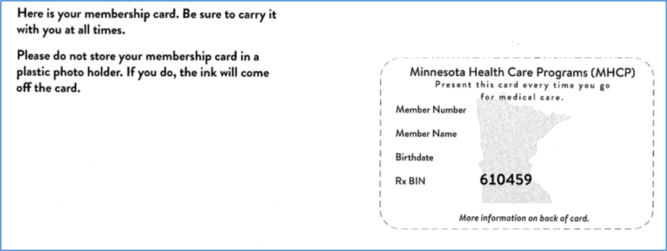
Each member has an MHCP member ID card. Always carry your member ID card with you. Show your member ID card every time you visit a provider.
If your MHCP ID card does not look like the one shown here, ask your (county or tribal) worker or the Health Care Consumer Support for a replacement card. Older cards may have old phone numbers for members and providers.
Having MHCP coverage eligibility does not guarantee that certain services or items are covered. Some services, prescription drugs, medical equipment or supplies may not be covered by a specific major program. Your MHCP member eligibility is generally approved on a monthly basis. Read through the Covered services and Specific health care services section in this EOC for covered services. You can also call HCCS with specific questions about coverage.
Using your MHCP coverage with other insurance
If you have other insurance, tell your worker before you get care. Also, show the cards for any other health coverage you have, such as Medicare or private insurance. We will coordinate our payments with the other insurance. This is called “coordination of benefits.” Examples of other insurance include the following:
When you become an MHCP member, you agree to:
If your insurance changes, call your worker.
Subrogation or other claim
The following paragraph applies to some noncitizens:
You may have other sources of payment for your medical care. These sources might include another person, a group, an insurance company or another organization. If you have a claim against another source for injuries, we will make a claim for medical care we covered for you. State laws require you to help us do this. We may recover the claim from any settlement or judgment you receive from another source. This is true even if you did not get full payment of your claim. The amount of the claim will not be more than state laws allow.
The following paragraph applies to MHCP members, except some noncitizens:
You may have other sources of payment for your medical care. These sources might include another person, a group, an insurance company or another organization. Federal and state laws provide that MHCP benefits pay only if no other source of payment exists. If you have a claim against another source for injuries, we will make a separate claim for medical care we covered for you. Laws require you to help us do this. The claim may be recovered from any source that may be responsible for payment of the medical care we covered for you. The amount of the claim will not be more than federal and state laws allow.
Private information
We and the health care providers who take care of you have the right to access information about your health care. When you enrolled in MHCP, you gave your consent for us to access this information. We will keep your information private according to law.
Provider information
You do not have to give documentation for services to MHCP. The provider must keep medical records of the services you get and the reason you get the services. If we need documentation, the provider will give it to us. The provider must ask for authorization when it is required and bill us for services. We can pay only providers, not you.
Minnesota Restricted Recipient Program
The Minnesota Restricted Recipient Program (MRRP) is a program for members who have not followed the rules for getting medical care or have misused services. If you are a restricted recipient or member, you may not pay out of pocket for services from providers to whom you are restricted.
You must get health services only from the provider or providers we designate (assign for you). You may be designated (assigned) one doctor, one pharmacy, one hospital or one other health service provider. You must remain in the MRRP for at least 24 months of eligibility for MHCP. You may be designated a home health agency or other providers. You may be prohibited from using the personal-care-assistance choice, flexible-use options or consumer-directed services. You will remain in the MRRP if you enroll in a health plan or change health plans. You will not lose eligibility for MHCP because you are in this program.
At the end of the 24 months, we will review your use of health care services. If you still did not follow the rules, you will be placed in the MRRP for an additional 36 months of eligibility. You have the right to appeal your placement in the MRRP.
Retroactive coverage
You may be able to get coverage for health care services you received in past months. This is called retroactive coverage. You can get retroactive coverage for certain reasons, including:
You must tell your health care providers as soon as possible when you receive retroactive eligibility for any reason. We cannot pay you back for medical bills that you paid. State and federal laws prevent us from paying you directly. The provider has the option to do one the following:
Interpreter services
If you need either a hearing interpreter or a spoken-language interpreter, let your health care provider know. You can also get an interpreter if you are the parent or guardian of a child patient who is under the age of 18. The provider cannot bill you for interpreter services.
MHCP covers the following interpreter services:
Interpreter services are available to help you get services. Face-to-face spoken-language interpreter services are covered only if the interpreter is listed on the Minnesota Department of Health’s Spoken Language Health Care Interpreter Roster.
Authorizations for services
Our approval is needed for some services to be covered. This approval is called either a prior authorization or a service authorization. Providers must get the approval before we pay for the service or item and, in some cases, before you get the service or item. Providers must get these authorizations so we can make sure the services or items are medically necessary for you and that you are getting the right amount of these services or items. For example, some services such as chiropractic care, have limits. Chiropractic visits are limited to six per month or 24 per calendar year. If you need more visits, the chiropractor must submit a request for authorization.
The provider will send us documentation when submitting a request for the authorization. After we review the documentation, your provider and you will get a letter telling you whether the authorization is approved or denied. If the authorization is denied, you have the right to appeal that decision. The appeal process is explained in the Appeal process section.
Refer to the Covered services section on what services need authorization.
Covered services
This section describes the major services that MHCP covers. Most of the lists in this section are not complete lists of all covered services. Covered services must meet MHCP rules and guidelines. In general, for MHCP to cover a service, the service, according to leading community standards and usage, must be:
For covered services at a glance, refer to the MHCP Benefits Chart.
Specific health care services
Most of the information listed in the specific health care services section outlines specific covered and noncovered services. Some services have limits or need an authorization.
Bariatric (weight loss surgery) services
Bariatric services are a covered service with authorization, doctor’s orders and a mental health evaluation. You may need to meet other specific conditions. Talk to your doctor about whether you meet the required conditions for this service.
Acupuncture services
Acupuncture services are covered for the following:
Child and Teen Checkups (C&TC)
C&TC is a health care program of regular checkups for children, teens and young adults from birth through 20 years. These checkups allow families and health care providers to monitor growth and development, screen for and identify potential concerns and treat them to prevent bigger problems later in life. These visits provide an opportunity to develop a relationship with your medical provider, discuss questions and concerns and support healthy habits. For teens and young adults, these checkups begin the journey of self-directed health care.
How often a C&TC visit is needed and covered depends on age. More visits can be scheduled as medically necessary, and it is recommended that children in out-of-home placement or foster care situations be seen more often.
Covered services in C&TC include the following:
Chiropractic care
Covered services are as follows:
Noncovered services from a chiropractor include other adjustments, vitamins, medical supplies, therapies and equipment.
Community First Services and Supports (CFSS)
MHCP members eligible for the following programs are eligible to receive CFSS services:
All CFSS services for Medical Assistance members need to have service authorization. You will receive a letter letting you know the amount of CFSS services you can receive. If we deny the services, or you disagree with the number of services you can receive, you can appeal. Refer to the Appeal process section.
Covered services include the following:
Refer to PCA/CFSS covered personal care services for noncovered services.
Dental services
Covered services include the following:
Some dental services require prior authorization. Members covered under Program HH (HIV/AIDS) Services have additional dental benefits.
Diagnostic services
Covered services are as follows:
A prior authorization is required for some covered imaging services.
Doctor, clinic, and other health services
Covered services include the following:
Blood and blood products
Noncovered services include artificial ways to get pregnant (artificial insemination, including in-vitro fertilization and related services; fertility drugs and related services).
Early intensive developmental and behavioral intervention (EIDBI)
Covered services are as follows:
Noncovered services are as follows:
Some EIDBI services require Service Authorization (SA).
The following services require authorization before service delivery:
The following services do not require authorization before service delivery, unless the service limit thresholds outlined on the EIDBI billing grid have been exceeded. All service limits apply to the person receiving services, not the provider.
Emergency medical services and post-stabilization care
Covered services include the following:
Noncovered services include emergency care, urgent care and other health care services you get from providers located outside the United States.
In an emergency that needs treatment right away, either call 911 or go to the closest emergency room. Show your member ID card and ask to call your primary care doctor.
In all other cases, call your primary doctor, if possible. The doctor or nurse will tell you what to do.
If you are out of town, go to the nearest emergency room. Show your member ID card and ask to call your primary care doctor.
Eye care and eyeglass services
Covered services are as follows:
Note: all other diagnoses or conditions require prior authorization for contact lens services and supplies.
Noncovered services include the following:
Family planning services
Under federal and state law, family planning services are open-access services. “Open access” means you can choose any physician, clinic, hospital, pharmacy or family planning agency to get these services. You can get the family planning services in the first list bel from any provider.
Some people are eligible for only family planning services and not any other services MHCP offers. Check with your worker or the Member Help Desk if you are unsure whether you are eligible for only family planning services.
Covered services are as follows:
Covered services that are not open-access services:
Hearing aids
Covered services are as follows:
HIV/AIDS programs (Program HH)
Program HH is a separate program that covers services for eligible people living with HIV. You may be eligible for Program HH only or in conjunction with other Minnesota Health Care Programs and Services, such as Medical Assistance. There may be some services covered under Program HH in addition to services covered under MA.
The information in this EOC does not apply to people who are eligible for Program HH only and are ineligible for other Minnesota health care programs.
Go to Minnesota HIV/AIDS programs or Program HH Services for more information about Program HH benefits.
Home and community-based waiver services
Home and community-based waiver services are not covered service for MinnesotaCare members.
If you are a Medical Assistance member, you may request an assessment for waiver services by contacting your county or tribal agency. The county or tribal agency will determine your eligibility.
Depending on the type of waiver program you are approved for, the following are some services MHCP can cover with an approved service authorization:
Home care services
Home care services are a covered service under the following programs:
Prior authorization may be required. The specific requirements to obtain an authorization are listed on each services webpage in the Provider Manual.
Covered services are as follows:
Refer to the Noncovered Services section of the Home Care Services page for a list of noncovered services.
Hospice
Covered services are as follows:
You must elect hospice benefits to get hospice services.
If you are under the age of 21 and getting hospice services, you can get services related to treatment of the terminal condition.
Hospital—inpatient
Covered services are as follows:
An inpatient hospital authorization is required for the following:
The following inpatient hospital services are not covered:
Hospital—outpatient
Covered services are as follows:
Housing Stabilization Services (ended Oct. 31, 2025)
Housing stabilization services are a Minnesota Medical Assistance benefit to help people with disabilities, including mental illness and substance use disorder, and seniors find and keep housing.
You must be approved to receive housing stabilization services if you are a Medical Assistance member. Contact your county case manager or a housing stabilization services provider to begin the approval process.
Covered services include the following:
Noncovered services include:
Refer to the Housing Benefits 101 Minnesota webpage for more information about Housing Stabilization Services.
Individualized education program (IEP) services
IEP services are available for members under the age of 21 if the services are specified in the IEP or individualized family service plan (IFSP).
Covered services include the following:
Investigational drugs, biological products, devices and clinical trials
As of July 1, 2022, a MHCP member who is in an approved clinical trial has coverage for medically necessary services that are otherwise normally covered by MHCP while participating in a clinical trial. Standard services that are approved by the federal Food and Drug Administration (FDA) and routinely covered by MHCP include, but are not limited to, IV administrations, routinely covered labs, X-rays, drugs and devices that do not affect clinical trial treatments.
Medical Assistance does not cover investigational drugs, biological products or devices as defined later in this section and defined by Minnesota Statutes, 62Q.526. Clinical trial treatments or related administered drugs, and services provided solely for the collection of data and analysis for a clinical trial and not for direct clinical management of the member, also are not covered.
Investigational drugs, biological products, or devices are defined as a drug, biological product or device that has successfully completed phase 1 of a clinical trial but has not been approved for general use by the FDA and is currently under investigation in an FDA clinical trial.
Medical equipment and supplies
Covered services include the following:
Noncovered services include the following:
You need a prescription or doctor’s order for medical equipment and supplies to be covered. Refer to the Medical Supply Coverage Guide in the Equipment and Supplies section of the manual to find out when an authorization is required.
Mental health services
Covered services include the following:
Treatment at Rule 36 (adult mental health residential) facilities that are not licensed as providers of IRTS is not a covered service but may be available through your county. Call your county for information.
Medication therapy management services
You can get medication therapy management services to help you better understand and use your medications.
To get this service, you must:
You can get this service at a clinic or pharmacy. A pharmacist can monitor your medications and give you the training to get the best results from them.
Moving Home Minnesota (MHM)
The services listed here are covered and available in addition to the Medical Assistance or MinnesotaCare services and any waiver services you are eligible to receive. The services listed here can be delivered without affecting your waiver budget. MHM services are not meant to duplicate, take the place of or extend services that are already covered by your Medical Assistance or MinnesotaCare benefit set or your waiver benefit set. If a service is already available under your waiver, it is not available under MHM.
Covered services are as follows:
The following services are also covered, but only if you are not on a waiver:
Refer to the Moving Home Minnesota Demonstration and Supplemental Services Table (PDF) for a complete list of MHM services and waiver interactions.
Nursing facilities
Nursing facilities are not a covered service for MinnesotaCare members.
If you are a Medical Assistance member, to be placed in a nursing facility, both of the following conditions must be met:
Covered services include the following:
Noncovered services include special services. Some members must pay their spenddown to the nursing facility.
Obstetrics and gynecology (OB/GYN) services
Covered services are as follows:
Personal care assistance (PCA) services
All PCA services for Medical Assistance members need to have a service authorization. You will receive a letter letting you know the amount of PCA services you can receive. If we deny the services or you disagree with the number of services you can receive, you can appeal. Refer to the Appeal process section.
For PCA eligibility, refer to eligibility for PCA/CFSS services. Covered services include the following:
Refer to PCA/CFSS covered personal care services for noncovered services.
Prescription drugs for members who do not have Medicare
Covered services include the following:
Noncovered services include the following:
The drug must be in our drug formulary. For a drug to be included in the drug formulary, the manufacturer must participate in the federal Centers for Medicare & Medicaid Services (CMS) drug rebate program.
You do not have to pay a copay for antipsychotic drugs used for the treatment of mental illness. You also do not have to pay a copay for drugs used for family planning or to help you stop smoking.
If a pharmacy person tells you the drug is not covered and asks you to pay, ask the person to call your doctor. Your doctor may need to prescribe a different drug that is covered. Your doctor may need to submit a special request, called a prior authorization, if your doctor thinks only a certain drug is right for you and that drug is not usually covered by your MHCP benefits. If the pharmacy will not call, you can call your doctor or the MHCP Member Help Desk.
Prescription drugs for members who have Medicare
Covered services include the following:
Noncovered services include the following:
Medicare pays for most of your prescription drugs through Medicare Part D. You must enroll in a Medicare prescription drug plan to get most of your prescription drug services. You will get your prescription drug services through your Medicare prescription drug plan. You may have to pay a copay for prescription drugs covered by your Medicare prescription drug plan.
Rehabilitation services
Covered services include the following:
Noncovered services include the following:
Substance Use Disorder (SUD) services
Covered services include the following:
SUD nonresidential (outpatient) group and individual treatment
Outpatient or nonresidential substance use disorder services are provided based on the identified individual need and member preference. SUD policy requires authorization be submitted to a medical review agent when an individual receives more than six hours or units a day or 30 hours or units a week of any combination of individual (H2035) or group (H2035 HQ) treatment services. This authorization process is only applicable for SUD nonresidential licensed programs.
Surgery
Covered services include the following:
Cosmetic surgery is not covered unless the service is determined medically necessary and authorized.
Transplants
Covered services are as follows (prior authorization required):
Organ and tissue transplants, including transplants of the following:
Transplant coverage includes the following:
A transplant must be done at a Medicare-certified transplant facility. Stem cell transplants must be performed in a facility that meets standards set by the Foundation for the Accreditation of Hematopoietic Cell Therapy.
Transportation to or from covered medical services
Covered services are as follows:
Nonemergency medical transportation for the following services are not covered because these services include transportation:
Urgent care
Urgent care is a covered service. An urgent condition is not as serious as an emergency. Urgent care is care for a condition that needs prompt treatment to stop the condition from getting worse. Urgent care is available 24 hours a day.
Noncovered services
MHCP does not cover the following health services or items for all providers:
Review the specific health care services section for more information about covered and noncovered services.
Billing
Your explanation of benefits
After MHCP makes payments to providers for services they provided to you, you will get an explanation of benefits (EOB). The EOB will show the name of the provider or provider group we paid, the amount we paid and the dates of service. If you did not get services from the provider listed on the EOB, contact the Office of Inspector General to alert of potential fraud. For contact information, refer to the Fraud section.
Some services are confidential. EOBs do not show when we pay for the following services:
Paying providers
We cannot pay you back for medical bills that you paid. State and federal laws prevent us from paying you directly. If you paid for a service that you think we should have covered, call HCCS.
A provider can bill you for health services or items not covered by us. Providers have to have you sign a form (Advance Recipient Notice of Non-covered Service/Item [DHS-3640] [PDF]) or Advance Member Notice of Noncovered Prescription [DHS-3641] [PDF]) saying that you will be responsible for the bill before you get the service or item. Providers are required to explain to you why the service or item is not covered and what services or items are covered that you could get.
If you choose to get services from a provider who is not enrolled with MHCP, you may be responsible for the cost of the services.
You may have to pay an amount toward the cost of some medical services to providers. This is called cost sharing. Review the Cost sharing section for more information.
Cost sharing
Cost sharing refers to your responsibility to pay an amount toward your medical costs. Cost sharing includes copays and a family deductible.
You will pay no more than 5 percent of your monthly family income for cost sharing. This may reduce the copay amount to less than the amounts listed here.
The following members do not have to pay copays or family deductibles for medical services:
Some services never have copays and family deductibles applied to them. These services include the following:
The following services also do not have family deductibles applied to them:
Please note, these lists are not complete. If you have questions about whether a copay or family deductible applies to a service, call the HCCS.
Also, the following providers cannot charge copays to MHCP or family deductibles to American Indian members, regardless of whether the members are enrolled in a health plan:
Copays
Some services have copays. A copay is an amount you are responsible to pay your provider.
2025 Fee-for-service copays | Medical Assistance and other programs | MinnesotaCare (when not enrolled in a health plan) |
Nonpreventive visit (such as for a sore throat, diabetes checkup, high fever, sore back, or other conditions) when services are provided by an advanced practice nurse, audiologist, chiropractor, doctor, nurse midwife, optician, optometrist, physician ancillary or podiatrist. These services include diagnostic procedures (such as a colonoscopy, endoscopy or arthroscopy). No copays are required for mental health visits. | $0 | $28; no copays for mental health visits |
Emergency room visit when it is an emergency | $0 | $100 |
Emergency room visit when it is not an emergency | $0 | $100 |
Prescription drugs No copays are required for certain mental health or family planning drugs. | $0 generic | $10 generic |
Eyeglasses | $0 | $10 |
Inpatient hospital | No copay or limit | $250 per admission |
Outpatient hospital | $0 | $0 |
Ambulatory surgery | $0 | $0 |
Radiology services | $0 | $45 per visit |
Nonpreventive dental | N/A | $0 per visit |
Durable medical equipment | $0 | $0 |
Pay your copay directly to your provider. Some providers may ask you to pay the copay when you arrive for the medical service. Other providers, like a hospital, may bill you after your visit. For example, a hospital may bill you for your nonemergency visit to the emergency room after the visit.
If you are enrolled in Medical Assistance and are unable to pay the copay, the provider still must provide the service. This is true even if you have not paid your copay to that provider in the past or you have other debts to that provider. The provider may still bill you for the unpaid copays.
Family deductible
A family deductible is an amount adult family members must pay each month toward health care costs. A deductible is separate from a copay. Effective Jan. 1, 2024, there is no family deductible fee. This amount is adjusted yearly and applies only to Medical Assistance.
Appeal process
If you disagree with a decision made by MHCP about a denial, reduction, suspension or termination of medical services, you can ask for a hearing. You must ask for the hearing in writing. You or someone who represents you must sign the request. You can request a hearing by filling out an Appeal to State Agency (DHS-0033) (PDF).
You must ask for the hearing within 30 days after getting written notice of the decision. If you show good cause for not appealing within this time limit, you may appeal up to 90 days after the notice.
After the Appeals Division gets your request, they will set a date for a hearing. You will be given the exact date, time and place. The hearing might be in person or by telephone. You can call the human services judge and request a face-to-face hearing if you have been scheduled for a telephone hearing. You can also call the human services judge and request a telephone hearing if you have been scheduled for a face-to-face hearing. The human services judge may have to schedule the hearing for a different day and time. Refer to Appeals frequently asked questions.
If we are stopping or reducing a service, you can ask to keep getting the service if you file an appeal within 30 days after we send you the notice (or 90 days with good cause), or before the service is stopped or reduced, whichever comes later. The treating provider must agree the service should continue. The service can continue until the appeal is resolved. If you lose the appeal, you may be billed for these services.
If you decide to file an appeal or ask for a hearing, it will not affect your eligibility for medical services.
Your provider may file an appeal or ask for a hearing on your behalf. You must give the provider your written consent.
You can have a relative, friend, advocate, provider or lawyer help with your appeal or hearing.
There is no cost to you for filing an appeal with us. Refer to Appeals, Help with an appeal, and Appeals contact information.
PCA and CFSS services during appeal
If we are stopping or reducing your PCA or CFSS services, you can ask to keep getting the same services when you file an appeal. You must file within 10 days of the date of the notice, or before the service is stopped or reduced, whichever is later. The services can continue until the appeal is resolved. If you lose the appeal, you may be billed for these services.
End in coverage
Your fee-for-service coverage with us ends when you become ineligible for MHCP or when you enroll in a health plan. If you enroll in one of our prepaid health plans, the health plan will give you an evidence of coverage. You will have to follow the health plan’s rules and use the plan’s network of providers.
Contact information
Health Care Consumer Support
If you have questions or concerns, call MHCP Health Care Consumer Support (HCCS). Health Care Consumer Support hours of service are 8:00 a.m. to 5:00 p.m., Monday through Friday.
Phone numbers: 651-297-3862 or 800-657-3672, TDD/TTY: 711
When to call your worker
Call your county or tribal worker when you have questions about eligibility for medical assistance and to report these changes:
Appeals contact information
If you do not agree with a decision we make, you have the right to appeal. (Examples of decisions include denials, reductions, suspensions or terminations of medical services.) You must ask for an appeal hearing in writing. You or someone who represents you must sign the request for an appeal. To request an appeal, fill out the Appeal to State Agency (DHS-0033) (PDF) form. For more information on appeals, go to our frequently asked questions about state appeal hearings.
Phone number: 651-431-3600 or 800-657-3510
TDD/TTY: 651-296-7385
Fax number: 651-431-7523
Fraud
If you think a provider or another member is misusing MHCP benefits, MHCP payments or the system in general, please report this fraud. You do not have to give your name or contact information, but giving that information might help investigators if they have more questions. Go to our How to report fraud page to find examples and to report fraud by member, by child care providers or by health care providers. You can also contact the Office of Inspector General:
Phone number: 651-431-2650 or 800-657-3750
Form: Minnesota Fraud Hotline Form
Accessibility contact information
If you have a hearing loss or speech disability, call the following numbers to access the resources listed in this EOC:
Definitions
The following are the meanings of some words in this EOC.
Action: an action includes the following:
Anesthesia: Drugs that make you fall asleep for a surgery.
Appeal: Your written request to us for review of an action.
Autopsy: An examination of the body of someone who died. It is done to find out what caused the person’s death.
Chemical dependency: Using alcohol or drugs in a way that harms you.
Child: Members under the age of 21.
Child and Teen Checkups (C&TC): A special health care program of well-child visits for members under the age of 21. It includes screening to check for health problems. It also includes referrals for diagnosis and treatment, if needed.
Clinical trial: A qualified medical study test that:
Copay: An amount that you may have to pay to the provider for specific medical services. Copays are usually paid at the time services are provided.
Cost sharing: Amounts you may have to pay toward your medical care. Cost sharing amounts include deductibles and copays.
Covered services: The health care services that MHCP can pay for when conditions are met.
Durable medical equipment: Equipment that can withstand repeated use. It is used for medical purposes. The equipment has to be medically necessary and ordered by a doctor.
Emergency: A condition that needs treatment right away. It is a condition that a prudent person believes needs prompt care, and without prompt care, it could cause one or more of the following:
Labor and childbirth can sometimes be an emergency.
Evidence of Coverage: The name of the document you are reading. This document tells you what services we cover. It tells you what you have to do to get covered services. It also tells you your rights and responsibilities and ours.
Experimental service: A service that has not been proven to be safe and effective.
Family deductible: An amount that adult family members may have to pay each month toward medical services.
Family planning: Information, services and supplies that help a person decide about having children. Family planning decisions include choosing whether to have a child and choosing when to have a child.
Fee for service: A method of payment for health services. Under this method, the medical provider bills MHCP directly, and we pay the provider for the medical services he or she provided. This method is used when you are eligible for MHCP but are not enrolled in a prepaid health plan.
Hospice: A special program for members who are terminally ill and not expected to live more than six months. It offers special services for the member and his or her family.
Inpatient hospital stay: A stay in a hospital or treatment center that usually lasts 24 hours or more.
Investigative service: A service that has not been proven to be safe and effective.
Medically necessary: Appropriate for the condition. Medically necessary care includes care related to physical conditions and mental health. It includes the kind and level of service. It also includes the number of treatments. It includes where you get the service and how long it continues. Medically necessary care must:
Medicare: The federal health insurance program for people 65 years of age or older. It is also for some people under the age of 65 with disabilities and people with end-stage renal disease.
Medicare Prescription Drug Plan: An insurance plan that offers Medicare Prescription Drug Program (Medicare Part D) drug benefits.
Notice of action: A form or letter we send you telling you about a decision on a claim or a service or about any other action taken by us.
Open-access services: Services for which federal and state law allows you to choose any physician, clinic, hospital, pharmacy or family-planning agency to provide them.
Outpatient hospital services: Services provided at a hospital or outpatient facility that are not at an inpatient level of care. These services may also be available at your clinic or other health facility.
Post-stabilization care: A hospital service needed to help a person’s condition stay stable after having emergency care.
Prescriptions: Medicines and drugs ordered by a medical provider.
Preventive services: Services that help you stay healthy, such as routine physicals, immunizations and well-person care. These services help find and prevent health problems. Follow-up care on conditions that have been diagnosed (like a diabetes check-up) are not preventive.
Primary care doctor or provider: The doctor or other health professional you choose for your routine care. This person manages your health care.
Prior Authorization: Health services that must be reviewed by Minnesota Health Care Programs (MHCP) using MHPC criteria and rules to before they can be covered.
Provider: A health care professional or facility approved by state law to provide health care.
Service authorization: Document used to identify services, providers and payment information for a person who receives home care, Alternative Care (AC) or waiver services. A service authorization allows providers to bill for approved services and DHS to audit usage and payment data.
Spenddown: People who have more income than the MA income limit allows may become eligible for MA coverage by spending down to the income limit. The spenddown dollar amount, similar to an insurance deductible, becomes the member’s financial responsibility before MHCP payment can be made.
If a member does not pay his or her spenddown, and it is the provider’s standard office policy not to provide services to patients with unpaid debt, the provider may refuse to provide ongoing services to that member, regardless of the member’s program eligibility. A provider may impose a late fee on a member’s spenddown if the member doesn’t pay their spenddown and the provider imposes late fees on all its patients. The provider may have to return late fees if later it is found that the member did not have a spenddown.
Subrogation: Our right to collect money in your name from another person, group or insurance company. We have this right when you get medical services that are covered by us and by another source or third-party payer.
United States: For the purposes of this Evidence of Coverage, the United States includes the 50 states, the District of Columbia, the Commonwealth of Puerto Rico, the Virgin Islands, Guam, American Samoa and the Northern Mariana Islands.
Urgent care: Services you get for a condition that needs prompt treatment to stop the condition from getting worse. An urgent condition is not as serious as an emergency. Urgent care is available 24 hours a day.
 Report this page