Minnesota Minnesota

Community-Based Services Manual (CBSM)

Community-Based Services Manual (CBSM)


External Program Review Committee (EPRC) agenda

Date: 2-4 p.m. on Oct. 5, 2023
DSD liaisons: Stacie Enders, Linda Wolford and Ari Dionisopoulos
Type: Whole committee
Location: Room 2222, Elmer L. Andersen Building, 540 Cedar St., St. Paul, MN 55101
Meeting link: https://minnesota.webex.com/minnesota/j.php?MTID=m18725c4007b15e4c653d9dc3ddd2064a
Access code: 2486 040 8341
Accommodations: If you need an accommodation for this meeting, you must notify a DSD liaison three days before the meeting. Email PositiveSupports@state.mn.us or call 651-431-4300.

Common acronyms used by the committee

We ask committee members to avoid the use of acronyms. Here are common acronyms:

  • · BIRF: DHS form 5148: Behavioral Intervention Report Form
  • · CABC: Context, antecedent, behavior, consequence
  • · DEED: Minnesota Department of Employment and Economic Development
  • · DHS: Minnesota Department of Human Services
  • · DLI: Minnesota Department of Labor and Industry
  • · DSD: Disability Services Division
  • · DSP: Direct support professional
  • · EUMR: Emergency use of manual restraint
  • · FBA: Functional behavior assessment
  • · HCBS: Home and community-based services
  • · IRP: Interim Review Panel (Predecessor to the EPRC)
  • · MDH: Minnesota Department of Health
  • · PCA: Personal care assistant
  • · PSR: Positive Supports Rule: Minnesota Rule 9544
  • · PSTP: DHS form 6810: Positive Support Transition Plan
  • General reminders for committee members

    Before speaking, please state your name. Committee members are expected to:

  • · Be on time.
  • · Read the minutes, agenda and supporting documents before each meeting.
  • · Participate in ideas and conversations, as well as pause to allow others to share input.
  • · Commit to spending the whole meeting time present and not engage in other activities during the meeting.
  • Technology

    The first few minutes of every meeting will be dedicated to addressing any connectivity issues, to ensure everyone can hear other meeting participants.

    Agenda items

    Public comments

    The committee encourages public participants to share their thoughts and ask questions about committee activities at the beginning of each meeting. The committee will continue on to the next agenda item when either 1) 30 minutes have passed or 2) when there are no additional comments or questions, whichever comes first.

    Vote

    The committee will discuss and vote on the minutes from September.

    Updates to share

    Behavior Intervention Reporting Form (BIRF) data

    Statewide totals of BIRFs submitted to DHS to report calls to 911:

    · Calendar year 2017: 1,853

    · Calendar year 2018: 2,024

    · Calendar year 2019: 2,180

    · Calendar year 2020: 1,954

    · Calendar year 2021: 1,957

    · Calendar year 2022: 1,934

    · Calendar year 2023 (through Sept. 18): 1,484 (if trend continues, then likely to be around 2,075 by end of year)

    Total 911 Behavior Intervention Reporting Forms (BIRFs) by Year: In 2017 there were 1853 BIRFs submitted by service providers to report a call to 911, 2018 had 2024 BIRFs, 2019 had 2180 BIRFs, 2020 had 1954 BIRFs, 2021 had 1957 BIRFs, 2022 had 1934 BIRFs, and 2023 is predicted to have 2075 BIRFs. The trendline is relatively flat with only a minor increase over time. It appears reports on calling 911 decreased during the years of the Covid pandemic (2020 through 2022).

    Statewide totals of BIRFs submitted to DHS to report emergency use of manual restraint (EUMR):

    · Calendar year 2017: 2,924

    · Calendar year 2018: 2,654

    · Calendar year 2019: 2,565

    · Calendar year 2020: 2,322

    · Calendar year 2021: 1,888

    · Calendar year 2022: 1,549

    · Calendar year 2023 (through Sept. 18): 1,172 (if trend continues, then likely to be around 1,639 by end of year)
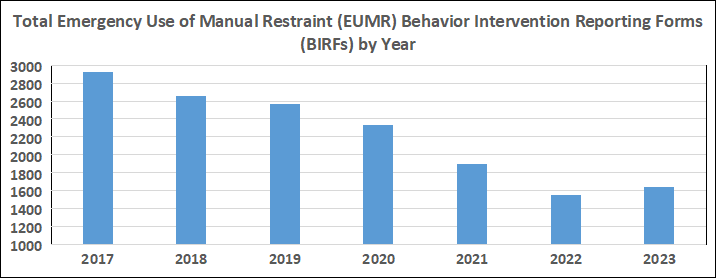
    Total Emergency Use of Manual Restraint (EUMR) Behavior Intervention Reporting Forms (BIRFs) by Year: In 2017 there were 2924 BIRFs submitted to report EUMR, in 2018 there were 2654 BIRFs, in 2019 there were 2565 BIRFs, in 2020 there were 2322 BIRFs, in 2021 there were 1888 BIRFs, in 2022 there were 1549 BIRFs, and in 2023 is it predicted DHS will receive 1639 BIRFs reporting EUMR. The general trend is a downward slope/a decrease in these reports over time.

    Direct care workforce shortage

  • · AASD and DSD eList: Rate and budget changes on Jan. 1, 2024
  • · The Nursing Home Workforce Standards Board was created in law during the 2023 legislative session to conduct investigations into working conditions in the nursing home industry and adopt rules establishing minimum employment standards reasonably necessary and appropriate to protect the health and welfare of nursing home workers. For full details,v visit Article 3 of 2023 Minnesota Session Laws Chapter 53.
  • · Direct Care Workers in the United States: Key Facts 2023 - PHI (phinational.org)
  • · AASD and DSD eList: Remember to apply for the PCA training stipend grant initiative
  • · NADSP, in partnership with ANCOR, is pushing to add a Standard Occupational Classification code for DSPs. See DSPs: Ask Congress to Recognize DSPs as a Profession! | ANCOR. Some benefits of this change could include:
  • It would provide a tool to collect more data on the profession nationally.
  • It would likely create more awareness of the profession.
  • It might be helpful in making decisions about wages.
  • One of the drawbacks is the change would classify DSPs separately from similar professions, such as PCAs. Competition between similar workers and the employers who hire them contributes to a host of industry problems among all types of direct care.

    Subcommittee updates

    Requests for approval subcommittee

    This subcommittee continues to assist providers with phasing out the use of restraint.

  • Emergency use of manual restraint subcommittee
  • This subcommittee will share a conversation they had regarding 911 calls and possible policy changes providers are making regarding calling 911.

    Discussion

  • Review of annual recommendations
  • The committee recommends DHS and committee representatives work towards the following goals (in no particular order) in 2023 to reduce the use of restraint:

    2023 Goal 1: Provide resources and guidance for improving communication skills

    The committee recommends expanding their 2022 goal related to communication. The new goal is to share existing or create new resources or materials for teams on how to support people with developing additional communication skills. The target audiences for this goal are service providers, lead agencies, direct care professionals and families because all members of the team have a role in supporting effective communication. Additional communication skills can be helpful in giving people greater control over their services and improving health outcomes. Many people who fall within the EPRC’s purview, due to use of restraint by license holders, need support with developing additional communication skills.

  • · The Minnesota Department of Administration and Minnesota STAR (with representation by Amy Perron, amy.perron@state.mn.us) did a webinar in September 2023 on tools and tips for supporting students who use augmentative and alternative communication (AAC) strategies. Some resources they shared during the webinar include:
  • · Free modules for training professionals are available through Project Core – A Stepping-Up Technology Implementation Grant Directed by the Center for Literacy and Disability Studies (project-core.com)
  • · The AAC Coach
  • · North Dakota Assistive - Homepage (ndassistive.org)
  • · OMazing Kids AAC Consulting | Angela Moorad, MS, CCC-SLP
  • · Minnesota Speech-Language-Hearing Association (MNSHA)
  • · AAC Language Lab
  • · PrAACtical AAC
  • · Simple AAC Archives - thinksmartbox.com
  • · The trainers reminded everyone that communication is more than just making requests. Teams should consider other concepts people might want to communicate such as sharing their thoughts or ideas, getting to know other people, asking how things work, teaching others, etc.
  • · In the training professionals were reminded:
  • Try not to fear the AAC device!
  • You are not alone. There is a team to support you and the communicator.
  • People should have access to communication tools at all times. Remember: The tool is the person's voice!
  • You don't need to be an expert. It's okay to make mistakes. It is a language that you learn over time.
  • Presume competency.
  • Build collaboration with other supporting professionals.
  • · It can be helpful for caregivers to use devices to communicate as well. It helps with learning how to use the device, recognizing areas for improvements and modeling skills to the person. However, honor if the person prefers that no one else use the device. Ask before using. Sometimes a print out or picture of the device will suffice for modeling.
  • 2023 Goal 2: Simplify and organize online DHS materials and training resources related to positive supports or intervention services

    There are many materials related to positive supports online, but the materials are scattered and numerous, and it can be unclear to service providers where to find information. There are also some gaps in the information. The committee recommends:

  • · Reviewing all DHS-owned positive support materials and related topics.
  • · Organizing the materials by topic and grouping related materials in fewer locations to reduce search times.
  • · Identifying the most helpful materials and removing less helpful materials to reduce clutter.
  • · Identifying gaps in resources, and developing new materials as needed to fill those gaps.
  • The goal of this project is to provide clear and easily accessible guidance to providers so they have the tools and knowledge they need to support people using services with living their best lives.

    2023 Goal 3: Explore ways to improve access to positive support services

    Waitlists for positive support services continue to be long, often taking several months to start services. This can be a safety concern for people and their teams when the person is engaging in serious aggressive or self-injurious behaviors. The committee recommends DHS continue working towards increasing positive support service capacity.

    2023 Goal 4: Support efforts to improve the direct care workforce shortage

    While many people have quality positive support plans, it can take months or even years to find positive support specialists or other direct caregivers to implement the plans or to provide general care. Additionally, turnover in these positions is common. As noted for 2023 Goal 3, this can be a safety concern for people and their teams. The committee recommends DHS continuing to support efforts to address the direct care workforce shortage, particularly efforts to improve wages and benefits for professionals who provide day-to-day care that reflects the complexity and skill needed to do the job well.

    Closing

    Members are invited to share additional updates and to recommend topics for upcoming committee meetings.

    Report this page